Sterile Processing is Your Highest Consequence Blind Spot
Sterile processing failures carry more catastrophic potential than nearly anything else infection prevention touches - a single lapse can reach hundreds of patients across months of time before it is identified. And what we find in our site assessments is that most infection preventionists spend less time in sterile processing than almost anywhere else in the building. That combination of elevated risk and decreased IP time and attention can be a problem.
Why are the consequences so much higher?
A hand hygiene lapse affects one patient encounter. A failure in reprocessing can affect every single instrument that moved through the broken process while it was broken. And you don’t always find out on day one … these failures are frequently discovered retrospectively, which means that by the time you know, the exposure window may already be months wide and the patient list is already long.
What follows identification of a problem is a lookback at prior work flows, impacted equipment and patients impacted. Then perhaps a risk assessment, health department consultation, and a decision about patient notification made under time pressure with incomplete information. Then the letters. Sometimes then the local news.
It is not an isolated clinical problem, it's an organizational event.
Where do reprocessing failures start?
They rarely start at the sterilizer - that's probably the most monitored step in the entire chain and the one everyone already watches. The failures often cluster earlier, in the steps that depend on one person doing something correctly with nobody watching. Common failure points include:
Point-of-use instrument management. Guidelines generally include immediate pretreatment at the point of care before transport. When that doesn't happen, soil and fluid dry on the instrument and every step afterward has to compensate for that extra bioburden.
Cleaning. If a device doesn’t get clean, sterilization cannot fix it. This is also the step most that is most sensitive to case volume and staffing pressure.
Drying. Particularly for flexible endoscopes with long narrow channels. Residual moisture supports biofilm, and biofilm survives high-level disinfection.
Storage and handling after processing is complete.
Staff Competency. Not whether the training happened, but whether the individual technician, on this specific device, following this manufacturer's instructions for use, can perform the skill effectively and consistently.
Flexible endoscope processing sits in a category of its own — complex enough that ANSI/AAMI ST91 exists specifically to address it, and needs it’s won focus and attention beyond the central sterile processing department workflows.
What do surveyors actually look at?
Surveyors frequently use “tracer” methodology, where they will select a specific patient and follow that patient's care across departments. Then, for patients with invasive procedures, they may run a second-generation tracer on the specific instruments used during that encounter. Which scope was it? Who cleaned and processed it? Where is that person's documented competency for that specific device?
That's a chain that either connects or doesn't. If there’s an observed fallout or failure point, policies don't help much at that point in the survey. What will matter is whether documentation exists for the individual who handled the individual instrument.
How would you know if there were a problem?
Honestly, many facilities wouldn't, until something happened that that forced the question and a deeper dive into processes.
An Italian teaching hospital investigated two KPC-producing Klebsiella pneumoniae infections following ERCP. When they sampled their endoscopes as part of that investigation, all ten were non-compliant, and seven grew high-concern organisms. They hadn't been sampling before, and so didn’t have information on what risks may have been present.
It is often one small event or issue that brings to light a much larger problem in the investigation.
What to look at on your next visit
You don't necessarily need a formal audit tool to start assessing your instrument reprocessing. Start by going to stand in the procedure room and decontamination during an actual case turnover. Watch whether initial cleaning is happening at the point of use. Ask one of the technicians to show you the manufacturer's instructions for the device in their hands. Look at where processed scopes are hanging, and how dry they are. Then ask for the competency file of the person you just watched work.
Ask questions about what they are doing and why they are doing it that way. If those questions produce an uncomfortable pause, that’s what you need to follow up on.
How we can help
If sterile processing hasn't had a close look recently, or your infection prevention program is stretched thin enough that SPD gets visited between other things, that gap is worth closing before someone else finds it.
IP&MA reviews reprocessing practice, competency documentation, and the workflows that move instruments through your facility, then delivers a written findings report with prioritized, practical recommendations. We also support facilities through reprocessing failures already in progress, including lookback scoping and patient notification decisions
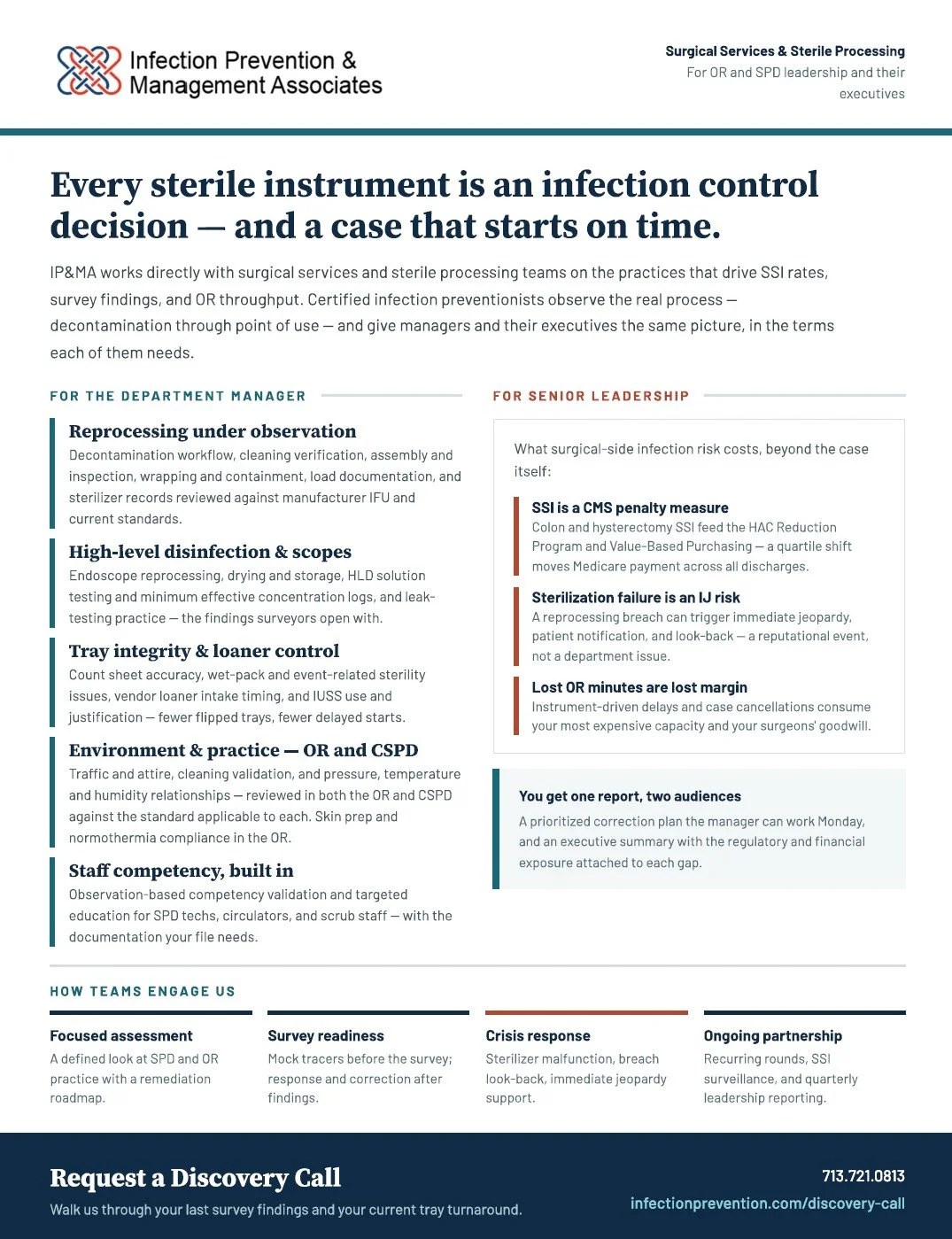
Download the flier below to help start the conversation about getting support for infection prevention and control in reprocessing, sterilization and high level disinfection.